Thursday, April 23, 2009

Upcycling Cardboard to Fine Art

Recently a fellow artist mentioned the subject of painting on corrugated cardboard, and how to avoid warping or buckling. I enjoy painting on atypical surfaces, and years ago I often painted on corrugated; I have a lot of trial and error experience with the material. First, let me state that art work with corrugated cardboard -- upcycling a refrigerator box to fine art, let's say -- is not archivally sound because the cardboard is going to have a high acid content. Cardboard isn't intended to last forever, but it can be made archivally stable. Good examples of how long art on paper, in general, can survive the years would be the known oil paintings on paper from the early 1700's! If you're going to be using oil paint on cardboard, make sure you keep the "fat" content low, and prime lightly with a bit of gesso if you like. The oil, or fat, in the paint is what would cause possible damage or decay in the future. Though oil won't cause the paper to buckle any use of gesso or other moist primer will. If you'll be working with any water based media then you'll have to be prepared for the cardboard to curl; paper warps with wet media... period.
It is possible to fight cardboard curl, buckle, or warp; plus make ordinary corrugated an archivally stable art material. Starting with a base coat of gesso will prepare the cardboard to better hold on to which ever type of paint you choose. Gesso will also slow acid from leeching through from the cardboard to alter your painting in the future, however gesso is brittle & can crack. A much better product to use as a base coat is clear acrylic gel medium. It's flexible, and it stops the acid in the paper from getting through at all; the acrylic polymers, in effect, create a seal. Liquitex makes an excellent heavy bodied gel medium that can be purchased at most craft & art supply stores, and because it's thick it doesn't warp as much as a base coat of gesso or paint. Oil paint won't adhere well to acrylic gel, so if you're using oil apply several layer of gesso after sealing with the gel medium.
Starting the center of the piece of cardboard, move a loaded brush of medium from top to bottom in a line; reloading as needed. Work swiftly. After applying an even line from top to bottom make another line on one side, then the other, of the first line. Allow the brush strokes blend, or feather, into the edge of the previous line to avoid building up texture that could show through your painting later. Work your way out to the edges, coating the piece evenly. Don't panic if it pulls up like a taco -- let it and don't push it down flat. When the first coat is dry, flip it over and coat the reverse in the same way. The taco curl should lay flat again as it dries because the tension on the surface of the material is even. After the back dries you'll probably want to do the front, then back, again before beginning your artwork. If it does warp while you're painting, keep the moisture level even by lightly misting the back with a spray bottle or re-coating.
If paint gets into the raw edges at any time then that paper corrugated on the inside can cause a warp. The solutions are to either avoid the edges altogether when painting or cover them with paper when base coating. With narrow strips of paper, and the gel medium, the cardboard can be perfectly sealed; acrylic gel medium has the added bonus of acting as an excellent glue! Just one fourth of an inch overlap one each side of the cardboard should be enough coverage. Be sure to "paint" the gel medium all over the strips, and if they slide, use less gel on the brush. Then coat them better after the first layer dries. The raised line of the paper strips will most likely be covered by a frame when the painting is finished. Keep the strips even and you'll have a nice clean edge.

Timber Land Steam Stack
 Unless exposed to very high humidity, or moisture, the piece of cardboard should now remain flat. Very large thin pieces may need some support that can be achieved with a frame and backing board. Covering the raw edges of the corrugated cardboard creates a seal that stops air or moisture from getting inside. Decay from acid oxidation is stopped, making a surface for art work that is archival, ready to be enjoyed for many years to come.

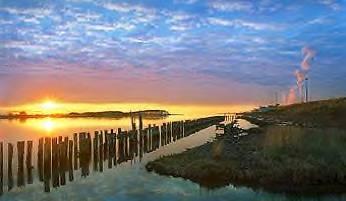
Shown at left is a painting assemblage where the same method was used, but with a full sized sheet of paper covered foamboard. As can be seen by the drips and running of the paint, I worked this very wet. This piece, a scene from the Pacific Northwest in my private collection, is several years old now and remains flat in the frame despite not having rear backing support. Titled "Timber Land Steam Stack", the curling form of a steam cloud is created from a recycled bent wood coat rack with cut out silhouettes of plastic coffee can lid ravens that free float from monofilament. Some of the ravens are adhered to the painting with acrylic gel medium. The bits of wood are wired to the foamboard, and so do provide a bit of rigid support. Coating and sealing the edges, however, is what prevents the foamboard from warping.

Explore and have fun! -- Tree


*Original art images ©Tree Pruitt, unless otherwise indicated. Contact the artist prior to ANY use or for purchase information.

Tuesday, March 31, 2009

Steinbeck Planted A Seed

Much of my artwork is inspired by the many places I've been too, and since I have again recently relocated I though it appropriate to share this entry from an old blog here.


28th Street Landing provided by the City of Hoquiam, WA
 I've travelled Americas highways more than most, being a chronic "tumbleweed" or Bohemian, and the interaction with so many personalities has had a wonderful effect on my art and self. I would love to travel Europe someday, but America is quite large enough. I have crossed it many times and still cannot hope to see it all. I was a fan of a book by the writer John Steinbeck when I was young, and that likely had an influence on my travel desire. He wrote, "Travels with Charley" that captured me with charm and adventure off the beaten path. Charley was Steinbecks dog, and I lived with one that looked just like him. Steinbeck had been asked to write about America, but he despised commercialism and tourist traps. He refused to write about or visit the mundane famous locations that middle class America drags children off to by droves each summer. He wanted the real people -- the real America. So he packed off with his dog in a tiny travel camper and went from town to town, staying off of the main highways and onto the back roads of America; That just sounded too romantic for me to resist!
Johns theory was that to know the people you must live with them. So from the time I was 13 years of age I have lived many places. I educated myself, utilizing the public library system in what ever town I happened to have landed in for a time. I "payed" for my education by offering my services in return to the library by performing tasks such as sweeping floors, reading to children and the elderly, working used book sales, artwork and signs, landscaping; what ever I could do. The closest I've come to growing roots under this Tree was the nearly ten years I spent in Washington State; the Great Pacific Northwest. I now find myself back in the family home in Ohio. My husband and I are both open to whatever the future may hold for us. But the Internet now makes it possible for me to grow roots, of a sort, under this Tree and I am grateful.
Life influencing art that influenced this artists life!

Sunday, March 29, 2009

Sketchbook vs Worksheet

The following is an entry from an older blog...


If I keep my blogs in any way as I do my journals and notebooks then it's likely to jump around a bit. My "notebooks" would likely be considered as sketch books by many. I don't consider them as such. Notebooks and worksheets work best for me. I'll often make a verbal notation of a scene or idea, rather than a visual image, to keep the mental picture firmly in my mind. Most often a page consists of a mixture of the two. They can be some what messy due to my tendency to grab a book and find a blank spot in a hurry. I do try to maintain some order though I suspect it's an order only I can see at times! :)
I prefer to make notes & worksheets before beginning a piece of artwork. That way I work out the idea but the actual exploration of the subject happens IN the art -- my passion for it is expressed during the creation of the piece. For myself there is always a great danger of burning out early on a subject; A concept has to continue to hold my attention in order for me to commit the time to give birth to it, if you will. If I allow too much early exploration through sketches then sketching becomes what I am doing. The sketch would become my response to whatever it was that urged me to create, and that may likely be the end of it. I rarely work the same subject more than once. If I do it is simply because I've not finished contemplating the topic of origin. On occasion, the first creation will inspire a second piece along the same topic line. So I do have series that I may return to from time to time --just as topics of conversation often arise out of the ashes of the spoken to spark to new life.
There are so very many things to think about that I cannot imagine ever running out of things to paint, or create on any particular subject. It really is quite like an insanity. I mean that light-heatedly, but there is a sharp pang of truth to it. A crazy life seems to be one of the requirements to the job of artist -- they don't tell ya that when ya sign up! :) But I do the best that I can to get through it with dignity, and try to produce the images in my mind's eye.

*Visit also "Pages From My Sketchbook" From Marion Bobby-Evans
* Artist Portfolio
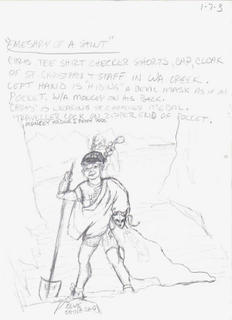
* Above image, "The Traveller", ©Tree Pruitt 1999. All rights retained. Example of a worksheet with both sketch & notes.


*Original art images ©Tree Pruitt, unless otherwise indicated. Contact the artist prior to ANY use or for purchase information.
Tuesday, March 3, 2009

Shift Happens

The Curio Castle Shoppe and my Fine Art Store at Etsy are going through some big changes. We're currently relocating our real world location (home), and so I thought it best to temporarily close both of my Etsy shops during this time. If you have a favorite item, you can contact me and still make a purchase provided you can afford some patience as we organise the storage. Good customer service and lovable products are always my priority, so I hope to resolve the situation swiftly.

Ongoing art projects too must sadly be put on hold for a while, and trust me this is the hard one for myself; shift happens, and shift we must. Overall I think the changes will be better for my family as well as my art work out put, but it sorely hurts to put a pause on things for now. I will be posting new photos of the in-progress sculpture, "Nature Goddess" as soon as possible.
Many thanks!
Tree Pruitt

Tuesday, February 17, 2009

Next Stage of Acrylic Portrait of Ivy

In the post just prior to this entry I told of an acrylic portrait painting of actress, model, and Go-Go Dancer Ivy Blue. Working from a photograph, I've developed my own interpretation of the overall image using thick brush strokes and vivid color.

Below are two photos of different stages of the painting. The image on the right shows the results after an evening spent working on the canvas; the left is a "before". These are just quick snaps in the studio, so the lighting is a bit off, but the colors are bold and vivid. Using acrylic gel medium in addition to the paint adds layers with depth, much like the effect of an oil painting, but still maintains that modern plasticity of acrylic. There are a few areas that still don't sit quite right with me yet, so I'll likely paint some more this evening.

*Later that evening ... Below is a peek at what is probably the now finished painting. Tomorrow I'll make some lighting adjustments and get a better photo posted. It's very textural. I need to let Ivy know it's finished! I hope she enjoys it.


*Original art images ©Tree Pruitt, unless otherwise indicated. Contact the artist prior to ANY use or for purchase information.

Monday, February 16, 2009

Acrylic Portrait of Ivy Blue in Progress


For some time I had to set the canvas painting aside and was only able to work with smaller or assemblage pieces. However, times have changed and I'm hungry to get my brushes back to some good dirty work! I really enjoyed working on the recent painting, "Wild Scarlet Macaw", so feel warmed up to return to some loved unfinished canvas paintings.

I was given the opportunity to work with images of a daring model known as Ivy Blue (her website). I'd begun two 16" x 20" paintings on canvas of Ivy; one in oil and the later of the two in acrylic paints. I'm sad to say that the oil painting is going to need to rest in storage for a while longer until I get moved into my new studio space. The acrylic version however is currently on my easel.

This piece excites me. I feel this painting is a good representation of my preference in style of brush work. The strokes are as bold and energetic as the subject herself exhibits in true life. My hope is that the complexity of each individual part will come together to create an image of both interest and beauty. I believe that only a few touches are needed to finish the piece, such as a strand of hair near the mouth area and the mouth itself. One can never really be certain what will happen when brush gets to hand, but can only have plans open to inspiration. I'm pleased, and a bit nervous, to share the completion of this painting.

Included is a quick photograph of the painting as it sits in the current stage. When I finish painting for the evening I'll take another photo so the progression can be seen. Please return again to see the final results of this painting and the next stage of the sculpture, "Nature Goddess", (see previous posts).


*Ivy Blue: Model, Actress, Go-Go Dancer


*Original art images ©Tree Pruitt, unless otherwise indicated. Contact the artist prior to ANY use or for purchase information.

Saturday, February 14, 2009

Finished Painting, "Wild Scarlet Macaw"

"Wild Scarlet Macaw", by Tree Pruitt.
11" x 14" acrylic paint on canvas board,
unframed but will fit standard frame without glass.


Please enjoy these first snap-shots of one of my most recent paintings, titled "Wild Scarlet Macaw". The available light sources were poor today, so unfortunately the white areas are a bit washed-out. Color variations and brush work are lost in most of these areas of the photos. At the left, see an example of the painting in a studio frame (frame not included when purchasing).

This unique piece incorporates both realism and abstraction, with Impressionist style brush strokes. The sculpted form of the bird arises from breaking the image up onto five separate canvas boards, the largest being 11" x 14", stacked and mounted to each other using heavy bodied acrylic gel medium. The image twists and morphs over the canvas boards. The edges are painted, and in many areas the design carries over onto another board. In other areas the image disappears, blending into the background.

The overall effect I desired to create was the experience of a Scarlet Macaw suddenly coming into the focus of the peripheral view; to mimic the action of a scene from a memory. The Scarlet Macaw (Ara macao) is a large, colorful parrot. The memory involved a walk through a jungle like path at a public zoo, where I'd paused for a moment without having noticed such a colorful bird right before my eyes! The macaw shook its head, catching my attention, suddenly becoming a keen color contrast against the green foliage. So the bird may not have been actually "wild", but the finished painting offers a wild view! The event made for a pleasant memory and a very enjoyable art project!

*Original art images ©Tree Pruitt, unless otherwise indicated. Contact the artist prior to ANY use or for purchase information.