Saturday, February 14, 2015

Art Prop Pests or Found Object Funk

Ugh, so I'm moving my studio around and cleaning - yes it happens to an artist too - when I discovered a little mound of "dust" on the table under a set of old antelope antlers that I have for still life reference. That's not good. That's in effect... cooties! I'm grateful to myself that I store items and supplies crafted for sale in sealed containers, but I worry for items such as my bear skull that were displayed very near those antlers that MUST be infected with a carpet beetle of some sort. Thankfully they seemed to prefer my specimens that still hold fur. This experience is something to keep in mind if you're prone to taking into your studio found objects and gifts from Nature. Personally I am mindful of the possibility of pests already, but it still happened to me! I've learned that even dried insects that one might be tempted to add to a collage or assemblage can hold tiny parasites that would be happy to munch away on your artwork unseen until damage is done! So now the battle has begun and my kitchen freezer is filled with baggies of bone, antler & fur as I hope to remove this invader and preserve props that have become special to me. The set of antlers came from a taxidermist years ago so I felt no need to take the same preventative measures that I would with an item gathered from the wild. But with arsenic having become illegal to use in taxidermy preparation every specimen added to your collection of oddities should be treated as a wild card.

BUT WHAT TO DO??

When I collect a dried insect or reptile from the wild, which I often use in my artwork, I first seal the specimen into a plastic zip bag and place it in the freezer for at least a month. Freezing should kill off pests on items that can't be treated with heat such as fragile insect wings that are commonly used in jewelry making these days. Before using it I will often spray it with a careful mist of rubbing alcohol or a cotton swab of the same if it won't damage the specimen, and though I don't know for sure if it helps with pests it does clean any remaining blood or residue well. Old fur coats and pelts can be dry-cleaned and that will take care of any parasites that they might hold. Woody items such as branches and leaves can be heat treated in the oven; times and temps will vary based upon the individual item. Bones can be boiled or baked. Metal items should be washed because they can hold some cooties too, but don't use a dish soap because it will kill a beloved rusty patina... boil and/or just use a gentle hand soap with really hot water (being careful not to get a tetanus tempting cut). IF you do find little piles of dust or tiny little worms on animal based products that you've brought into the house removing the offending article, cleaning the area, and putting the thing sealed into a deep freeze should do the trick.

Hopefully this blog post will help some of you. It certainly made me feel better to know that there are things that I can do and that discovering a few cooties isn't the end of the world, or the end of my antlers!


*Original art images ©Tree Pruitt T. E. Pruitt, unless otherwise indicated. Contact the artist prior to ANY use please.

Friday, June 20, 2014

A Flash of Fiction

I had a fun little experience with words the other evening, and the result turned into 'Flash Fiction'. Flash Fiction is just what it sounds like, but for most writers it's more complicated than it seems because the entire story has to be word-painted in a very small space. The fun thing about it is that the limited space forces some of the traditional story elements to get pushed aside - unwritten. Those elements must then be insinuated or implied within the written storyline, and the ending is often open or questioning, leaving individual readers to create different interpretations.
 I didn't set out to write at all that night, especially not knowing much about Flash Fiction. My goal was to fill a need for written words to add to a visual collage. It didn't really matter what the words meant as I didn't think they'd be read-able in the art anyway. Because I'd removed all restrictions it seems that creativity flowed, and before I knew it I'd written a little 'something'. I never did add written words to that collage project, but in the next few days I did move with a succession of creative ideas and art related problem solving, so I can't help but feel that I patted the Muse's back by letting the writing out and She patted mine by zooping up my projects with fresh energy.

Read my mysterious Flash Fiction foray titled, What Now. 


*Original art images ©Tree Pruitt T. E. Pruitt, unless otherwise indicated. Contact the artist prior to ANY use please.

Friday, April 18, 2014

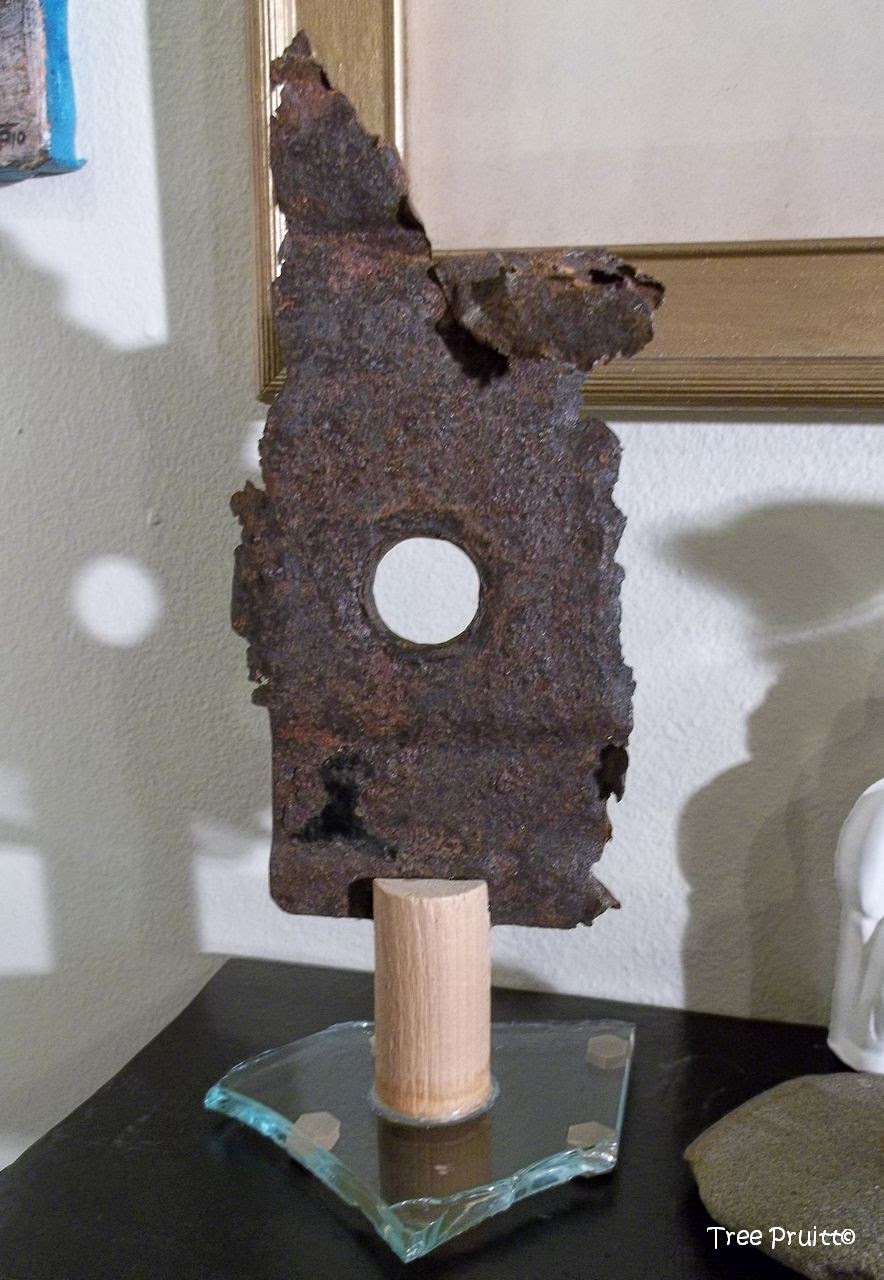
Rusty the Cycloptic Rabbit Minimalist Assemblage Sculpture

Ah the inspiration of Spring! With the melting of the snow, and Easter just a hop around the corner, I was inspired to create an assemblage sculpture bunny that's turned out rather Minimalist in style. Being comprised of found objects ol' Rusty here nearly made himself! I found a bit of rusted and twisted metal that had been flattened in the road by a huge bulldozer and couldn't help but notice that it looked like a rabbit, thus Rusty the Cycloptic Rabbit was born! I scrubbed him down with rubbing alcohol and a wire brush to clean him up a bit -- cleaning rust sounds crazy, I know, but with all the rust he WAS a bit of a flake. Then I hand cut a groove into a cylinder of wood so that the metal fit snugly and glued the parts together with a strong adhesive.

The base is an object I wish I hadn't found, but is an example of making the best of a situation. That very same huge bulldozer at one point had shaken my house with such a boom as to cause a glass shelf to bounce out of its holding mount and crash to the floor! No worries (once the cursing faded) because destruction facilitates creation and I was hoppy to have the glass shards to add to my creation.

 Though I encourage textural art work to be touched this is a piece of art to be explored with care because this bunny can bite with some sharp edges! I like the broken edges of the glass showing because the green color reminds me of grass. The wood body piece attaches to the glass base with a clear silicone adhesive. Quality rubber bumpers act as feet for the sculpture to both lift it and protect display surfaces.

"Rusty the Cycloptic Rabbit Minimalist Assemblage Sculpture", by Tree Pruitt (T. E. Pruitt)


*Original art images ©Tree Pruitt T. E. Pruitt, unless otherwise indicated. Contact the artist prior to ANY use please.

Monday, February 17, 2014

Cradled Birch Painting Panel

An old favorite paint brush sits ready to gesso a birch panel.
I began a new journey with an old friend tonight by pulling out a favorite paint brush to get started working on my first cradled birch panel. I've painted on birch in the past and really enjoyed the surface, but the cradled panels sturdiness is an exciting new experience! The brush I used is from Baker's Secret and was actually intended for basting food, but I discovered that it held other secrets! I've been using it since it was new for water media so much that the handle has developed patina over the years. The bristles are similar to hog bristle but offer a smoother toothy texture in base coats.

 I began with the panel right from the package. Without sanding I brushed a thin smooth coat of acrylic gesso over the top and sides of the panel, following the wood grain. As much as I want to do this painting it was a tough choice to cover that lovely even birch grain! There are so very many things that could be done with these boards, and I'm looking forward to using pyrography in a future project! The gesso sucked into the raw wood and dried quickly. The second layer that I applied was lain thicker and with random brush strokes to create texture. Once that dried I pulled out a jar of old white acrylic paint. Being towards the bottom of the jar the paint has thickened to a tacky paste that, when applied, brushes further texture out onto the surface. When that dried I was left with a wonderful mildly slick bright surface begging to be marked... I WAS left with it, but that quickly changed as color found its way onto my brush and painting has now begun in earnest!


*Original art images ©Tree Pruitt T. E. Pruitt, unless otherwise indicated. Contact the artist prior to ANY use please.

Thursday, January 23, 2014

Old Soldier Assemblage Sculpture

"...an old soldier who tried to do his duty as God gave him the light to see that duty."
The last soldiers of the First World War have left us now. The 100th anniversary of the outbreak of that war will be in August this year, and with that in mind a few recent finds called my imagination to create assemblage art. A modern television set color cap became a helmet, an old light bulb fixture from a now demolished building became the form of a soldier, his eyes staring with dazed rings created from antique Parcheesi game pieces -- glue and etched markings on the light bulb glass resemble gently falling tears. With a plastic toy gun the soldier stands at the ready in a field of daisy like upholstery tacks which, though surrounded by fencing made of metal nails representing the dangers of barbed wire in the field, has not yet turned to become the life sucking mud of the First World War trenches. There is hope. He will fight. He will win the battles that life sets before him and thus always remain a soldier.

 Though from a different war, the light bulb and theme of a soldier then called to my mind a famous phrase used by General Douglas McArthur in his farewell speech, "old soldiers never die". Around the wood base of the assemblage sculpture are those words pieced together from magazine cut-out letters pasted into place.

"I am closing my 52 years of military service. When I joined the Army, even before the turn of the century, it was the fulfillment of all of my boyish hopes and dreams. The world has turned over many times since I took the oath on the plain at West Point, and the hopes and dreams have long since vanished, but I still remember the refrain of one of the most popular barrack ballads of that day which proclaimed most proudly that "old soldiers never die; they just fade away."

 And like the old soldier of that ballad, I now close my military career and just fade away, an old soldier who tried to do his duty as God gave him the light to see that duty."

-- General Douglas McArthur in his farewell speech to Congress

►First World War Centenary http://www.1914.org/why_remember/

►Check availability of this artwork by clicking HERE.


*Original art images ©Tree Pruitt T. E. Pruitt, unless otherwise indicated. Contact the artist prior to ANY use please.

Wednesday, July 10, 2013

Falling Together

It's been a stressful past couple of years, to say the least, but my art survives the artist folly, and I am regenerating. There'd been a terribly complicated matter that led to the loss of my inventory catalog of paintings... and most ALL of my collection of actual unsold paintings ... my personal collection. Many where rescued by the general public from tragic fate by those who just happened to see art that they liked -- that is the biggest honor an artist can receive, and I am thankful to those people!! Some works of my art have sadly met fates unknown to me still. What can I say now other than the modern phrase that "*it happens"; Floods and financial disaster have plagued many an artist in the past and they still persevered through the trauma -- as I intend to do. Not that I equate myself with a Master by any means, but Picasso said something to the effect that once an artwork leaves the artists' studio it has a life of its own -- independent of the creator whether sought or sold. May my creations life well! 

Wednesday, June 26, 2013

Pink Japanese Magnolia Tree in Bloom

Rather than "on" my easel this canvas has just come off of my easel... "Pink Japanese Magnolia Tree in Bloom" is a water-colour pencil painting on canvas of a very large old tree that I'm blessed to share space with in this life. I really enjoyed drawing the tree onto the canvas and moving the flow of water from my paint brushes to enhance the forms! I look forward to the possibility of painting another version of this tree in (albeit exaggerated color) full bloom, as I've enjoyed observing it's growth over a few years now -- a twinkle in its growth span! Due to the diameter of this trees sprouting trunks I can only imagine that it must be 100 years or more in age -- an early example of a hybrid species of flowering trees in America! Add in the fact that this tree is left to chances in a semi-urban environment and it is truly an amazing example of survival, beauty, and luck (or Divine intervention). I've enjoyed this tree a great deal, and consider sharing life space with it as one of the high points of my time living in Indiana.


I began with a double primed cotton canvas. The image was drawn free hand with only 3 colors of Faber-Castell Albrecht Durer water-colour pencils -- Walnut Brown, Wine Red, Phthalo Blue -- then very few black accents were added. The background was enhanced with additional Light and Emerald Green pigment pencils with the Walnut Brown. A Burnt Ochre was then added in areas of the tree for highlight shadow. All of the white highlights (darkened here due to photograph lighting) are the white of the canvas showing through. Once dried for several days after painting I sprayed several coats of a fixative over the water-colour pencil paint, then carefully brushed over layers of acrylic varnish to seal the painting to a finish.

At this point the original painting is not for sale because my dear husband has requested that it remain hanging in our home for personal enjoyment... the BEST payment that an artist can hope for is to have a painting enjoyed!


*Original art images ©Tree Pruitt T. E. Pruitt, unless otherwise indicated. Contact the artist prior to ANY use please.

Wednesday, January 2, 2013

Brightening the Post-Holiday with Blues

"Crystal Water" wire mobile by TE Pruitt. In the depths of Winters moody darkness it's helpful and fun to find projects to craft that will add a bright spot to your spirit. I decided to craft up a new brightness in our lives by making a glass bead wire mobile. The holiday season this year found our home filled with sparkle, light, and decoration, but after it had passed taking down the ol' Yule tree left us feeling less than festive. Once replaced, the candle holder that usually hangs in the archway where the lit tree had been sitting looked dark and dull. I didn't want us starting a new year with a dull feeling hanging around, so that's where I put the mobile! A slight touch or a breeze will start the beads to movement, catching the light and also moving Chi life energy around. I wrapped some quartz crystals and used blue beads that look like frozen drops of water and captured air; We here are both Fire signs, so the energy of Water should offer a calming balance to us and Air should feed the fire of our creativity. At the bottom of the mobile hangs a faceted heart which not only sparkles nicely but hangs there to represent the desire for our loving energy to continue to effect our environment in positive ways and for that love to grow in the coming year. Over time too the steel wire will likely oxidize a bit changing into a nice warm red, which will certainly cause us to continue to enjoy the piece as well as serving as a reminder that change can be a good thing. Overall it's just a hanging wire mobile, but as with everything handmade it's what it means to the person enjoying it that matters most!
 Now that the excitement of the holiday season has passed don't let your inner artist go hungry... feed it some good energy by crafting up a project that will light up your life in some way that's special to you!

Happy new year to you all! --Tree
 
"Crystal Water" wire mobile by TE Pruitt.


*Original art images ©Tree Pruitt T. E. Pruitt, unless otherwise indicated. Contact the artist prior to ANY use please.

Friday, November 16, 2012

No Scrub Clean For Old Brass

  Want a no hassle scratch free approach to cleaning darkened old brass? Vintage and antique metal components are great additions to art work, but sometimes an age patina doesn't turn out to be so charming. Don't waste time rubbing away patina-poo and risk scratching delicate brass bits! Just dip it... dip it good!
Before & After

 I'm currently working on an assemblage art sculpture, and some of the old brass items that I want to use have tarnished too much. There are a lot of different methods for cleaning brass and copper. Many like vinegar, rubbing alcohol, and ammonia produce strong smelling odors that can not only stink up a studio room but also may be harmful to breath! Because I didn't want to scratch the surface of the brass, and because I'm a busy person too, I decided to use an easy dip soaking method.

 The product I chose was simply Mr. Clean... with Febreze®, so it smells great in addition to working like a breeze! Just pour some of your favorite scent of undiluted Mr. Clean into a shallow dish, then add the brass bits. Make sure everything is covered by the cleaner and allow to soak several hours, depending on the severity of the tarnish. The product has even performed well for me at removing the green oxidation that can sometimes chew into brass, copper, and other metal. Without scrubbing or rubbing the brass will emerge clean with a soft shine. If not then soak a while longer, and for an extra boost renew the cleaning fluid if it turns very dark in color.

The first photograph that I've included shows a before and after effect on an antique brass corner guard. The guards had pieces of old tape stuck fast to them and had developed an unattractive patina over who-knows how many years. The cleaner softened the adhesive very quickly, so that the tape simply wiped away. I allowed a piece of tape to remain stuck in place during an over-night soaking to show the before and after effect. The dark rectangle where the tape used to be is the before color of the metal; Look how bright the rest of the corner guard is! All of the brass surface had been that black or darker. When your items are finished soaking be sure to rinse them very well to remove any residue. Except for rinsing, the cleaning process is basically hands free, but the best part is that it smells so good!

 Before I glue down the metal objects that will go onto my assemblage I will wipe them with rubbing alcohol to ensure good adhesion; If it still smells like cleaner then the cleaner is probably still there, and rubbing alcohol should do the trick. The Mr. Clean product will remove most all paints and many types of varnish, so do have care and test a spot before using on any surface. Now that cleaning the metal parts of my project is finished I can move on to the fun part of assembling the art. I love using this easy cleaning method! Stepping out of the studio to reach under the kitchen counter can make an artist breath easier and the work itself a real breeze too. ;)


*Original art images ©Tree Pruitt, T. E. Pruitt, unless otherwise indicated. Contact the artist prior to ANY use please.

Tuesday, July 10, 2012

Vintage Funeral Mask Comes To Life

After 1st cleaning before remount.
 It feels good to take care of my kitsch and transform it into home decor. Have you heard of the Death mask of Agamemnon? I've always been somewhat enamored with Bronze Age Greece (c.2500-1100 BCE), the Minoans and Mycenaeans, so when I noticed an old souvenir reproduction of the famous funerary mask in a box lot it was quite a find! I was thrilled to add it to my small collection of funeral art and masks.

The original artifact is a mask of gold that was found in 1876 by Heinrich Schliemann in Mycenae. It was dubbed as the "Mask of Agamemnon" because Schliemann was convinced that he'd discovered the final resting place of the mythical king of Mycenae, commander the united Greek armed forces during the Trojan War. The mask, however, is most certainly not the face of Homer's fabled king because it is much older than the historical Agamemnon.

When I received my version of the mask it nearly resembled an artifact dug out of the ground, likely having spent many years boxed in a garage. It was mounted to a padded trophy shield of black velvet and faux green paper crocodile skin. The velvet had lost its fuzz and was worn threadbare on the edges. It was dusty, and the metal had begun to "green-up" in a few places -- a damage that will continue to spread if untreated. So I cleaned old Aggie up and put him aside until I got around to creating a new background mount.

The first photograph shows the "before" and the second photo is the nearly finished product. It's resting in a regular picture frame now but will soon go into a glass encased shadow box frame for protection from dust and debris.

I started by brushing some Cardinal Red craft quality acrylic paint over a large piece of archival sketch paper. When that dried (thank you blow-dryer) I crinkled it firmly into a ball. The chalky texture of the paint cracks open a bit in the crinkles exposing the soft paper, which I then smoothed flat and washed with a thin coat of Burnt Umber craft acrylic paint. I wiped off the Burnt Umber with a soft moist cloth then let the paper sit overnight. The next day I adapted the design from images of genuine Mycenaean fresco using Antique White and various blue craft paints.

After the design was finished I coated both sides of the paper with Liquitex Acrylic Varnish. The high amount of acrylic polymer in the quality Liquitex product increases the lightfastness and gloss of the craft paint plus protects the surface of the metal mask from chemicals that could migrate up from the paper or paint. The painted paper was then attached to paper board using PVA glue. The mask was originally wired onto its old mount but over time the weight of the piece had begun to pull it out of shape. I opted for thick dabs of hot-glue as reinforcement. It's a strong hold yet could be removed for re-mounting in the future.

I'm happy with the level of protection I've given to this piece and enjoy it much more than when it was mounted to a dirty black base. Time well spent!

Learn more...
http://en.wikipedia.org/wiki/Mask_of_Agamemnon
http://en.wikipedia.org/wiki/Agamemnon


*Original art images ©Tree Pruitt, unless otherwise indicated. Contact the artist prior to ANY use.

Thursday, April 19, 2012

Rusty Old Sign


Managed to get out for an inspirational walk a few days ago and snapped a few photos. I'm fond of the rusted old lettering on this sign. I also like the quirky division of space in this photograph with that misty blue sky against the rough red bricks.


Digital photograph of a rusted sign on an old brick building in town (Kokomo, Indiana).
See a larger image and prints of this image that are available at my deviantArt Gallery...
 Old Building: Shipping and Receiving, by Tree Pruitt 2012


*Original art images ©Tree Pruitt, unless otherwise indicated. Contact the artist prior to use.

Tuesday, April 17, 2012

Dot Line and Scribble

This new painting is an impression of imagery inspired by the 1965 Jazz musical animation short, "The Dot and the Line: A Romance in Lower Mathematics" (MGM), which was inspired by a book that Norton Juster had written a few years earlier. The painting was begun just before the passing of influential animator and producer of the cartoon, Chuck Jones, and was just recently finished to a point where I feel good when I stand in front of it. I enjoy what the layers of paint do in the light, in addition to the somewhat whimsical theme. This is one of those instances where I don't care very much whether or not a viewer "gets it". Usually I care a great deal about the final imagery when dealing with art that is Conceptual and/or Representational especially, but when I began this painting I was feeling the unhindered abandon of "Scribble". I'd found a copy of the original book which of course brought to mind the cartoon that had jazzed me up so much as a kid (big Tom and Jerry watcher here), and that was plenty to get the inspirational fires burning for fun. Overall I supposed this painting is/was about self gratification and experimentation... mine as well as the characters in the story.

"Dot Line and Scribble" by Tree Pruitt
"Dot Line and Scribble" by Tree Pruitt, 30" x 20" oil painting on canvas.
I wanted to not just paint but to see what the paint would do. The paint rests on the canvas in several layers. At the time I'd begun I was working often with dark under-paintings, so I knew I wanted to play with something bright that time. In some of the lightest areas the gesso of the canvas prime shows through as a matte white. Strokes of slick Titanium White feather over that and into a warm mix of colors with overlapping strokes. This allows the light in a room to pass through those textured layers, giving a sense of vibration. In my photos it seems to look blotchy and dingy rather than shimmery because, though I may photograph a lot of things well, photographing my canvas art is something I've not mastered. At the bottom of the painting a muted green was scraped via pallet knife over the bright layers while they were still slightly tacky to the touch so that they smeared and mixed a bit.
"Dot Line and Scribble" by Tree Pruitt

One of the reasons it's taken so long for this painting to feel finished has to do with some of the methods I used. I wanted to be sure of the paintings soundness (no music pun intended there) before calling it as finished. The thick line that passes through the middle (Indian Red) was forced to crackle. Without having an over-the-counter crackle medium at hand I experimented with using a medium that improves paint adhesion, and I also removed some of the oil from the paint (via setting it on absorbent paper) for a fluid mixture. I applied that over the old layer of paint with a higher fat content, then waited for that to set-up. After a few months the line did indeed crackle! After a few more months passed I scrapped at the line with a razor blade to remove any flakes of paint that had cracked up and to reveal the lighter colors underneath randomly. I like the effect. The final touches that were added included a thin solid black line over top of the thicker crackled line. This line of Lamp Black paint was given a high amount of oil (fat) to a mixture of the same adhesion medium. In theory it should not crack, but should remain solid for the life of the painting (knock on wood).

Always a beloved inspiration theme, a bit of a tribute to a beloved artist, and a fun project that I think worked.


"Dot Line and Scribble" 2012 by Tree Pruitt, 30" x 20" oil painting on canvas. *Original art images ©Tree Pruitt, unless otherwise indicated. Contact the artist prior to use.

Friday, April 13, 2012

Assemblage of Thoughts On Bricolage Art

Bricolage [bree-coal-ahj] is a visual arts term used to describe art that is created from an assemblage of everyday objects and/or items that happen to be at hand during the artists need for creative expression. Personally, bricolage and assemblage arts haven't turned me into a pack-rat though it may encourage the habit to hoard... I only save the good stuff. What makes stuff good or garbage? It's hard to say just what it is that attracts an artist to a particular object. I think that the heart of bricolage is that creative impulse though... the need to create or express overpowering the need to wait for more traditional art materials to become available. Rather than create a sketch with a shopping list the bricoleur must look, wait, and jump when the moment is right in order to get that perfect object or flash of inspiration.
 Assemblage art and bricolage are siblings but not quite twins. An assemblage artist often works with the same methods, techniques, and/or materials in each art work with a fairly good concept of how those items will come together before the project begins. This also creates a recognisable "style", often with layers of encaustic wax, thick paint, industrial or architectural elements, old keys and vintage toys as favorite materials of many assemblage artists today (and rightly so because they are cool). The art of a bricoleur however will be unlikely to resemble other pieces created by the same artist to any high degree because the same materials may not be available, and things have to be assembled with different methods for nearly every project. The bricoleur is saying, "I need to make something... now! What do I have?" Perhaps assemblage art stems from a desire to take unwanted objects to make them into something wanted and attractive, whereas bricolage stems from a simple desire to make; It doesn't necessarily care if it's attractive because it just "is" or the artist felt that it simply needed to happen.
"Restrictions" by Tree Pruitt

In my opinion pure bricolage allows a viewer to see the components as they are, but put together or used differently from the original purpose... like using masonry blocks and plywood as a bookcase. Assemblage art often, but not always, embeds or disguises objects by using them as parts of a whole. My own piece titled "Restrictions" is one of my favorite examples of bricolage expression, though the final results were closer to assemblage than bricolage. I'd found myself with an overwhelming emotional need to express creatively while low on art supplies. With just a couple of tubes of paint and some glue in hand I rummaged through the house until I found a thing to use as a base, a thing to use as the actual thing, and then stuff to go over the thing. Only then did I have an understanding of what thing I was going to make -- a confined human figure. I wrapped heavy duty fishing line around a (clean) bed pillow and metal pipe then placed a vintage foam wig form on top as a ready made skull. Upholstery fabric was then wrapped over that and drip painted to resemble a dirty old thing dug out of the ground because at that point I'd taken to the concept of archaeology's mummy bundles, which are often tied and bound in order to hold the body in place. The concept was perfect for my expression though it wasn't present at the start of the project where only the emotional need to express was there. The everyday-ness of the components is hidden inside something that looks totally different from the things that I started with, so that is why I'd consider Restrictions as not being pure bricolage.
"It's Only Natural", Tree Pruitt

A more purist example of bricolage within my own art work is the assemblage sculpture "It's Only Natural", which is composed of objects I found while walking around an old timber mill lot. Here there was no emotional drive to create, but the piece was inspired by what the objects seemed to naturally resemble... or imply. On the reverse side a metal clamp and two rusty bolts hold the parts together while also acting as representations of internal female reproductive organs, once the mind has entered the realm of sex; A special stone that naturally resembles a penis helps the mind wander that way. It could be a statement about sexism, about the timber industry, environmentalism, textures, or just the way things sometimes come together. A viewer can think whatever they like when looking at the piece, but the facts are that the materials are natural (even metal being an element) and unhidden.

Musician Frank Zappa said, “Art is making something from nothing and selling it.” An artist uses many tools, but to an assemblage artist or bricoleur anything can become a tool of the trade, and even the tools themselves can become the art. "Portrait of the Artist" (shown above, digital photograph by Tree Pruitt 2012), is a self portrait created from a combination of tools, materials, and even the art studio environment. In this tech based world of art the camera indeed has become the artists other eye with which to see and show things to the world, and so it is here reflected in an old mirror as the all-seeing-eye. For a portrait of an artist to be true it should show the "hand" of the artist within the work and indeed this image does. In the background there is a thin material that screens away the reality of the studio floor in separation from the "higher" plane of the art work. Are you buying that?? It's really just a picture of a plastic thing and a window screen on the floor, but I think it "sells" as an appropriate portrait of this artist.
Some relevant links...


*Original art images ©Tree Pruitt, unless otherwise indicated. Contact the artist prior to ANY use.

Thursday, April 5, 2012

Zenful Assemblage Art

Buddha Window Assemblage
This piece of assemblage art, "Buddha Window Assemblage", was made entirely of found objects that were collected, rescued, and reused to give old so-called garbage new life via a different form; I love to upcycle vintage treasures! It is true magic at work when such totally unrelated items can fit together in a way that feels unforced yet new! What I most enjoy about this piece is the ambiguity; depending upon how it's viewed, both figuratively and physically, the piece can either be of spiritual enlightenment or sociopolitical confinement -- happy or sad, mostly dependent upon how the viewer approaches the Buddha (again both figuratively and literally).

Click images to view enlarged.
The parts that make up the piece are few. The frame was saved after having tested a company's product where a tile fell out and broke; The frame was new, so why throw it away? The next layer of the piece is an uncommon one... a window that was never meant to be looked out. The white metal frame is a salesman's sample from a window manufacturing company, complete with black screen material and ribbed rubber seal. These mini windows were far too cool to allow them to get trashed, so it's great to use one here as what certainly must represent the industrial hand of mankind framing a spiritual perspective. Then from an antique pottery sake cup that was, sadly, broken emerges the Lord Buddha. From behind him is a bit of rusted railroad steel rising like flames. The metal Buddha figure has been cleaved off of a well loved, but totally worn out, incense burner. The left, or heart, side of the figures chest is missing. The heart hasn't been cut out but removed from the scene, perhaps for safe keeping or perhaps it was stolen somehow. No matter the frame of mind or perspective taken this piece offers a window for contemplation with clean lines, warm tones, and varied texture which I feel is a successful representation of zenful assemblage art.

Buddha Window by Tree Pruitt, 6" x 6" x 2" 2012-13


*Visit my shop site

*Original art images ©Tree Pruitt, unless otherwise indicated. Contact the artist prior to ANY use.

Friday, March 23, 2012

Polygonia Butterfly


A Polygonia butterfly, specifically here the Question Mark Butterfly (Polygonia interrogationis), resembles both a moth and a dead leaf when it's wings are closed because of the drab brown color on the underside of the wings and "hairy" appearance. Personally I think it looks like a cameleon with those eyes! :) This friendly critter joined me on the patio one day to pose for some photos. Learn more about them at Wiki http://en.wikipedia.org/wiki/Polygonia_interrogationis or see the great photos here http://www.carolinanature.com/butterflies/qmark.html 


*Original art images ©Tree Pruitt, unless otherwise indicated. Contact the artist prior to ANY use.
Thursday, January 12, 2012

Varity Is Vital

  One of the things I like to do outside of the realm of visual art involves music. I play with a bass guitar. Notice I didn't say that I'm a bass player? That's because I've only actually learned enough over the years to cause some trouble if the volume's turned up too far; I play with it. It doesn't matter if it's good or bad quality playing to me because how it feels is more important. An added bonus is the emotive quality of the instrument because it can help to clear out a mood. If I'm about to work on a bright happy painting but the day has been gloomy I can dump those blues out with the bass. The fingers and wrists get a powerful change of activity from visual artwork action! I notice that the muscles in my upper arms get stronger too the more I play, which allows for greater endurance and a more steady hand when painting. Much of the same holds true for the legs because just like when working on a larger sized painting Rockin' out happens best when standing. So my entire body gets a kick in a different direction when I'm playing the bass versus when I'm painting, drawing, or sculpting.

  Years ago while working on my first full wall mural I learned the importance of diversifying action... the hard way. The painting was of a near life-sized African Acacia tree; a fairly large project! The branches bent around two walls and onto a high ceiling. Each branch had one or two creatures that might actually be on the savannah; from tiny termites crawling up the trunk to a well fed leopard lounged over a branch all his own. When the entire painting was close to a finish I noticed a smaller off-branch up high offered a perfect spot to add a rich red oxpecker bird, so I grabbed the step ladder and paint pallet. As excitement grew I really got focused on what I was doing; placing tiny little detailed feathers and a few surrounding leaves. Holding my hand as still as possible I repeated the same motion over and over to create consistent paintbrush strokes. Sound nice? I thought it was, but I was wrong.
  After the third day in a row of pecking away at the oxpecker I awoke with a very stiff wrist. By the end of that evening swelling had reached up to the top of my arm, and the pain was rather intense. I went to the emergency room for a shot to decrease that swelling! Eventually a diagnosis of tendinitis was offered, and I was told to stop painting altogether; Of course, that was not going to happen. Since the true culprit had been pointed out as the repetitive action I decided that variation needed to become a hotter spice in my life. I now end each evening with therapeutic stretching exercises. Fitting other types of art and craft activities into my week, rather than only painting or drawing, seems to have been the biggest help of all though. I rarely have an issue with my wrist these days.

  Certainly most any method to vary your own activity is probably good, whatever the motivation, but don't overlook an old band instrument hiding in a closet or attic if you have one. Wait until you're alone, dust it off, and make some noise! You don't have to be good, just have fun. Overall I think that playing with a musical instrument offers the best benefits for a visual artist as an alternative activity because it involves so many of the same fine muscle groups but uses them differently. Plus creativity could be opened, and what artist doesn't want to risk that?

  So, that's one of the ways I get my kicks when I'm not painting. What sort of things do you do when you're not doing your usual thing?


*Original art images ©Tree Pruitt, unless otherwise indicated. Contact the artist prior to ANY use.

Friday, December 30, 2011

Making the Most of Art Supplies

Making the most of supplies is crucial, considering the cost, but it can also be a step to furthering creative exploration. When I have paint left on the pallet after finishing a painting I use it. I keep stacks of small sheets of thicker than usual (110# acid free) paper on hand to create "waste pages". This paper will warp if too wet so with acrylics it's best to move quickly with big strokes to cover the sheet for future background use. If there's still paint left over I grab another sheet and have at it. It's freeing to feel so wasteful, using up sheet after sheet in a careless way. It's also a great way to unwind after working on a serious project that maybe required concentration; it takes painting back to a fun place. This can be continued until the watered down paint is only a wrinkling stain on the page if desired. Then, the real bonus comes in the treasure trove of potential art that can be discovered in those waste pages; backgrounds for smaller paintings, ACEO, book markers, collage and scrapbooking material, postcards, paper mosaic, etc. I've even had that pallet mud brown -- you know the color when all colors are muddied together -- turn out to make a terrific wood grain when torn into strips for a collage painting.

Image 1
 Here is an example of one of my waste pages in action. I'd finished working with Liquitex Heavy Body Acrylics. I brush scribbled a general abstract pattern onto the paper using the colors I had leftover, (see image 1).


Quite some time later I wanted to paint the antique tea roses that grow outside my studio and found this waste page to be an amazing match for a composition that was already sitting in a vase on the dining table! The resulting painting, titled Tea Roses in Little Vase, has a greater depth and spontaneity than it would have been able to achieve if I'd started with blank white paper. I really enjoyed the ease of having a background already prepared too.
Image 2


Buckled pages can be smoothed later by flipping over onto a smooth table top and wetting. Use a 1" to 2" wet brush and start from the center. Don't stroke back and forth too much or the paper will stretch out of shape. Just wet it evenly until the paper lays smooth and flat onto the table. Place one or two sheets of an inexpensive thinner paper like a 30% post-consumer recycled copier paper on top and weight it all down with heavy books for a day or two. Once the paper is dry it should lay flat for use as a painting or drawing background, sitting flat inside a frame later.


Image 3

Another bonus to using up extra supplies comes in the challenge of only using the leftover colors at hand. In this little self portrait (see image 3) I had a lot of blues left on the pallet and a half dried chunk of white not wanting to be wasted. Glancing in the studio mirror I quickly grabbed some lines with the loaded brush.
 Because the main goal is to use up the paint my brush was allowed more freedom than usual. The resulting image was a good deal more moody than I felt at the time, and more stylised than I'd perhaps have expected, but that's what adds to the fun.


So hold on to your pencil nubs and scrape the pallet clean for creative ways to gets the most out of your art supplies and get the most from them!


*Original art images ©Tree Pruitt, unless otherwise indicated. Contact the artist prior to ANY use.

Friday, September 30, 2011

Rainforest Inspired

This month has featured numerous days of rain in my area. My houseplants are loving the soft light and the art studio is nicely cooled. So far, no hot Indian Summer like I'd expected, but enough rainy days in a row to make me think back to when I lived in Washington state. Here are two bits of art, a painting and a poem, that were inspired by the misty Pacific Northwest rainforest.


~ My Eye Will Not Forget ~

Blurred vision of a distant horizon --
Cedar rhythms dance my eye --
American rainforest a-drip with neon green.
Rivers run my pulse.
Sunset explosion of fiery, bright orange --
Solid color fills the sky,
As if upon another world!
The trees come down to kiss the shore
Where Pacific waves have their way.
Red forest trails --
My eye is filled with wonder!
Water hovers in the air.
Faces look from shapes in trees;
Primordial magic!
Moss beds and alder swamps,
Blue mountains hold a burning secret.
My eye will not forget.

©Tree Pruitt
Artwork shown, "The Road to Aberdeen", oil on canvas painting by Tree.
*See a previous post about this piece, here.


*Original art images ©Tree Pruitt, unless otherwise indicated. Contact the artist prior to ANY use.

Saturday, September 24, 2011

Finished Nature Goddess Sculpture

 In each of the places I've lived in North America I've encountered nature spirits. Inside the mysterious trees and brush one thing can often look like another at first glance. Have you ever walked in the woods and mistaken a log for an animal or caught unexplained movement out the corner of your eye? Some say that the cautious creatures of magic in the woods disguise themselves to avoid capture. Who can say if they are really there or not? I wanted this recent sculpture to have that ephemeral feeling of both natural and supernatural that makes one take a second look in curiosity. If it has a meaning greater than that then we'll ponder on it together.
close-up of "Hamadryad" by Tree Pruitt
In a previous blog entry I shared an assemblage statue I'd begun titled at the time as, Nature Goddess Sculpture, well she's finished now and enjoying a spot on a curio shelf. From the base of the marble stone to the painted tip of the highest feather she stands thirteen inches tall. Click the link to see pictures in the old post of how this piece began. She has become a North American hamadryad, with her head-dress of native bird feathers; red cardinal, yellow finch, and black raven are represented in her crown.

Wikipedia informs us that hamadryads, "are Greek mythological beings that live in trees. They are a particular type of dryad, which in turn are a particular type of nymph. Hamadryads are born bonded to a particular tree. Some believe that hamadryads are the actual tree, while normal dryads are simply the entities, or spirits, of the trees. If the tree died, the hamadryad associated with it died as well. For that reason, dryads and the gods punished any mortals who harmed trees."

"Hamadryad", sculpture by Tree Pruitt

My Hamadryad statue could be understood by some to be an unhealthy tree because of the plethora of bracket tree fungus she wears up her trunk, but I don't think of this fungus as a death symbol. Also known as Artist's Conk, this particular species is Ganoderma lucidum, which is a type of fungus I've personally observed on living trees. This species is a hard textured annual with a shiny red -brown top surface when dormant. The underside of this "Artist's Conk" yields a mat surface like a dusting that darkens when touched or scrapped. Marks will become permanent, allowing artists to express creative images on the surface. I've enjoyed watching this species shape itself to the contours of tree trunks over the years, as if poured into place, until it becomes a very firm part of the tree; attempting to remove them is quite difficult and harmful to a living tree. Overall, it may be harming the ash and locust trees I've observed it growing upon, but they've thrived for well over forty years so far, with the fungus growing only in the low shadows.
 
This sculpture is considered by myself as an "assemblage". An assemblage is simply taking parts already made and putting them together to make something else. It certainly has been an assemblage of inspirations! Here, though the surface is carved and formed similar to a traditional sculpture, the body is made of different parts. A pine wood dowel rod runs upwards, and this isn't just a support structure because I've left a portion visible as torso. The foundation is a base of marble chunk. The clay is attached to this base making it a permanent part of the piece.

I was nearly sad when this assemblage sculpture was finished. I had great fun working on this piece. Paperclay as a medium has proven to be very versatile when mixing into my 3-D artwork. I enjoy the final results of this project, and I hope you've enjoyed it too!


Browse my studio store to see available artwork Visit Tree's ArtFire Studio


http://en.wikipedia.org/wiki/Hamadryad
http://botit.botany.wisc.edu/toms_fungi/march99.html
*Original art images ©Tree Pruitt, unless otherwise indicated. Contact the artist prior to ANY use.